





Blogs

Leave New Relic’s compute-capacity meter and proprietary syntax behind. Standardize on OTel and Prometheus and keep only telemetry worth your attention.
Trusted by everyone from startups to the Fortune 500







Looking for the New Relic plugin? Monitor New Relic data within Grafana.
Visit plugin pageGrafana Cloud is a fully managed observability platform that teams choose as a New Relic alternative for its consumption-based pricing, native OpenTelemetry support, and open, vendor-neutral architecture. Unlike New Relic's CCU metering model, Grafana Cloud lets teams reduce costs with Adaptive Telemetry while keeping full data portability.
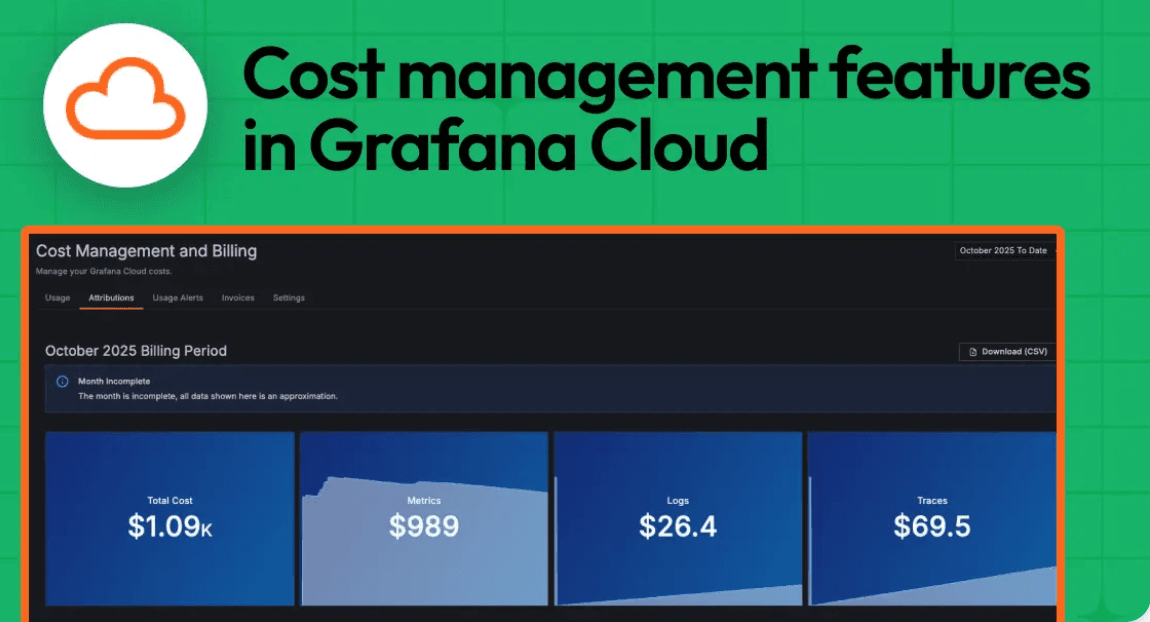
Rather than paying for unused telemetry and user seats, see your top cost drivers and eliminate waste with Adaptive Telemetry. Aggregate rarely-queried series, drop low-signal logs, increase trace and profile sampling rates during anomalies.
Avoid proprietary agents and query layers that lock your data in one cloud and force a nonstandard language. When agent updates ship new features that auto-enable by default, ingestion can increase before you’ve reviewed and tuned configuration. Instrument with OpenTelemetry, standardize on Prometheus conventions, and query with PromQL over open backends so your telemetry stays portable and your controls stay yours.
Investigate incidents with AI from a single shared view across your telemetry backends and the other tools you already use. Pivot from a span to the exact logs or metrics, then open profiles to see CPU hotspots. Run on-call and incidents in IRM and validate fixes with k6 so you resolve with fewer handoffs and less tool switching.
“After moving off New Relic to Grafana Cloud, everyone at IGS can log into the same place, so Support and Engineering work from the same dashboards instead of handing off tickets. When we hit a persistent intermittent drop, we spun up k6 tests, fed the results into those shared dashboards, and resolved it much faster.”
Bring in 24×7 support plus Professional Services to scope, plan, and drive implementation and migration work, so you’re not left translating a ticket thread into an operating system
“We solved our [Observability] problems, our cost problems were solved, and our pricing and unpredictability were also solved. We now have a predictable solution and a partner who works well with us, and we’re happy with where we are with Grafana Cloud. Not to mention, our support team is happier too.”
Capabilities |  |  |
|---|---|---|
Predict and control your costs | Usage-based pricing with Adaptive Telemetry: analyze traffic by label/team → aggregate under-utilized metrics (Adaptive Metrics) → drop low-value logs (Adaptive Logs) → tail-sample traces (Adaptive Traces). Learn more | Get metered in Compute Capacity Units (CCUs) whenever you run a query, evaluate an alert, or invoke an API call, which makes spend harder to forecast as usage scales. When pricing programs shift over time, budgeting can feel like trading one cost model for a more complex one. |
Use open standards and retain portability | Native support for OpenTelemetry (OTLP), PromQL, TraceQL, and standard backends (Prometheus/Mimir, Loki, Tempo) so workflows and tooling remain portable. Learn more | Billing uses Compute Capacity Units (CCUs)—every query, alert evaluation, or API call consumes CCUs, making growth hard to predict. |
Shorten time from alert to resolution | Correlate metrics, logs, traces, and profiles in a single Explore workspace; manage incidents via IRM/OnCall, and validate fixes with k6 performance tests. | You query, alert, and investigate inside the New Relic boundary—tool hopping still required for full context. |
Bring in external data easily | Connect to 150+ data source plugins (cloud, DB, SaaS, OSS systems) and correlate signals in Grafana Cloud without forcing ingestion into a single vendor backend. Learn more | Best optimized when data is ingested into New Relic’s stack—external sources need transformation or duplicative pipelines. |
Migrate with minimal disruption | Use a coexist → consolidate → replace path: keep incident workflows running, migrate telemetry signals gradually, and cut over when ready. | Supports ingesting open telemetry, but migration from legacy tools often means dual-running, new syntax (NRQL) and re-training. |
Gartner evaluated 20 vendors based on their Ability to Execute and Completeness of Vision, and Grafana Labs was positioned furthest in Completeness of Vision.

Gartner®, Magic Quadrant™ for Observability Platforms, By Gregg Siegfried, Matt Crossley, Padraig Byrne, Andre Bridges, Martin Caren, 7 July 2025
Gartner and Magic Quadrant are a trademark of Gartner, Inc., and/or its affiliates.
Gartner does not endorse any company, vendor, product or service depicted in its publications, and does not advise technology users to select only those vendors with the highest ratings or other designation. Gartner publications consist of the opinions of Gartner’s business and technology insights organization and should not be construed as statements of fact. Gartner disclaims all warranties, expressed or implied, with respect to this publication, including any warranties of merchantability or fitness for a particular purpose.
This graphic was published by Gartner, Inc. as part of a larger research document and should be evaluated in the context of the entire document. The Gartner document is available upon request from Grafana Labs.

Align on a migration timeline
Set and agree on key outcomes
Identify potential blockers early
Build open communication channels

Define observability requirements
Catalogue existing observability assets
Develop a migration blueprint
Design Grafana best practices for your organization
Whether you’re trying to cut costs, simplify your stack, or just get more out of your telemetry, Grafana Cloud can help.

Welcome to
Built on open source, open standards, and open ecosystems


